





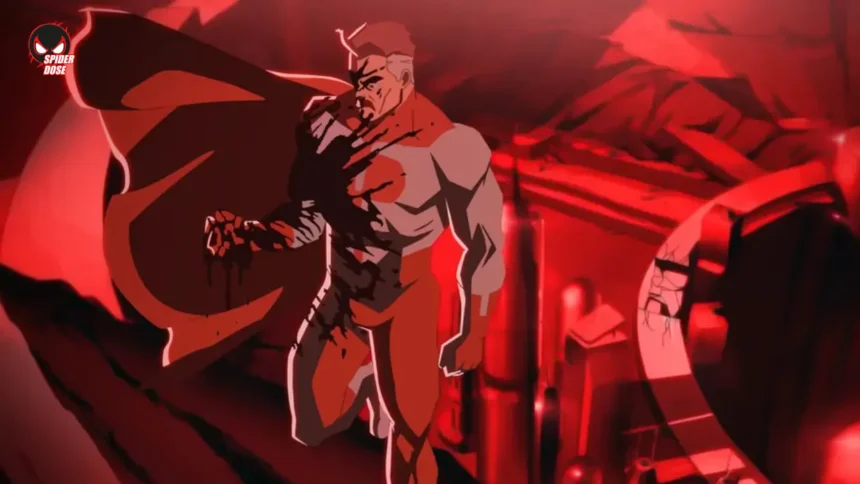
Here’s a fact that stops most fans cold: Omni-Man massacred Earth’s greatest superhero team — the Guardians of the Globe — in under two minutes. No speeches. No mercy. Just brutal, calculated violence. So when we ask whether Omni-Man could defeat the Justice League, we’re not talking about a typical comic book rivalry. We’re talking about one of fiction’s most ruthless killing machines walking into a room with some of the most powerful beings in the DC Universe.
- Our Methodology: How We’re Judging This Fight
- Who Is Omni-Man? Feats, Limits, and Lethality
- The Justice League: Strength in Depth
- The Superman Factor: The Fight That Defines Everything
- The Flash Problem: Speed Force vs. Viltrumite Reflexes
- The Magic and Mental Threats: Where Nolan Gets Exposed
- Omni-Man’s Critical Weaknesses: What High-Level Fans Know
- Scenario Analysis: How the Fight Actually Goes
- Our Verdict: The Logical Conclusion
- Frequently Asked Questions | Omni-Man defeat the Justice League
This question has fueled fan debates for years, and honestly, it deserves a real answer — not a fanboy hot take. So let’s build one from the ground up.
Our Methodology: How We’re Judging This Fight
Before we dive in, let me be clear about the versions we’re analyzing. We’re comparing Omni-Man from the Image Comics/Invincible series (primarily Invincible #1–144, by Robert Kirkman) against the Justice League from DC’s Post-Crisis and New 52 continuity — the most commonly cited comic versions. Using the DCEU or animated versions shifts the math significantly, so we’ll flag those differences where relevant.

We’re evaluating each fighter across five categories: Physical Strength, Speed and Reflexes, Durability, Vulnerabilities, and Combat Psychology. No plot armor. No emotional bias. Just what the source material actually supports.
Who Is Omni-Man? Feats, Limits, and Lethality
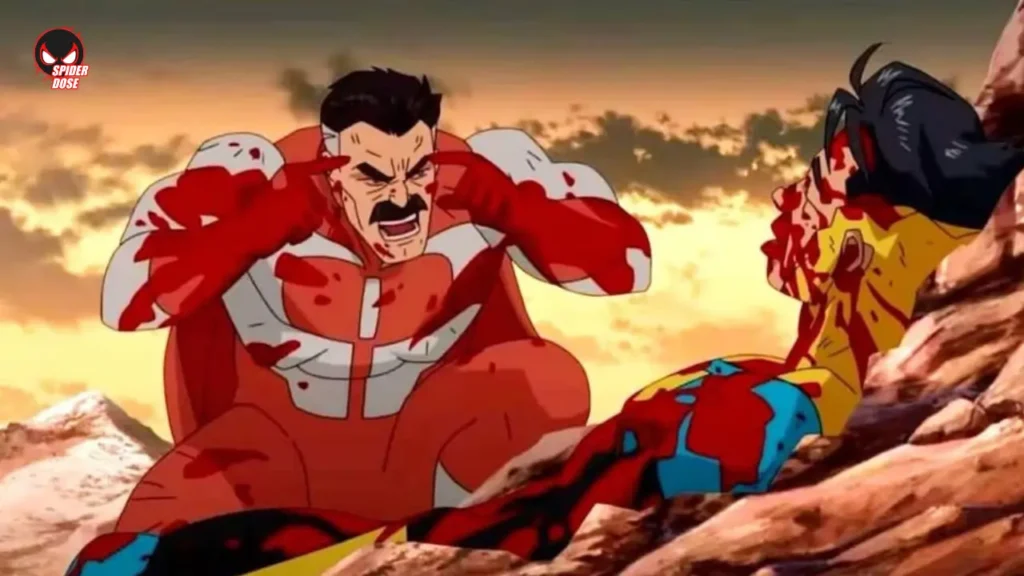
Omni-Man, born Nolan Grayson of the Viltrumite Empire, is not simply a Superman clone. He’s a warrior bred over millennia for conquest. His physical feats in the comics are staggering — he survived combat against the Viltrumite warlord Thragg, one of the strongest beings in his universe, and continued fighting after taking damage that would kill almost any other character.
What Makes Him Genuinely Dangerous
His strength ceiling rivals low-to-mid-tier DC heavy hitters. He can fly at interstellar speeds and survive in the vacuum of space indefinitely. Critically, he can hold his breath for up to two weeks, which neutralizes many environmental attacks. He also heals faster than a baseline human, though not at the regenerative rate of, say, a Green Lantern construct.
However — and this is important — Viltrumite power is not solar-dependent. Nolan doesn’t absorb a yellow sun to become stronger. His physical limits are biological and, therefore, fixed. He cannot grow infinitely stronger the way Superman theoretically can under optimal solar conditions.

The Psychological Weapon
What separates Nolan from most heroes is his mindset. He has no moral hesitation about killing. He will go straight for a fatal blow, exploit hesitation, and target vulnerabilities without remorse. Against a team that often pulls punches, this is a massive tactical advantage.
The Justice League: Strength in Depth
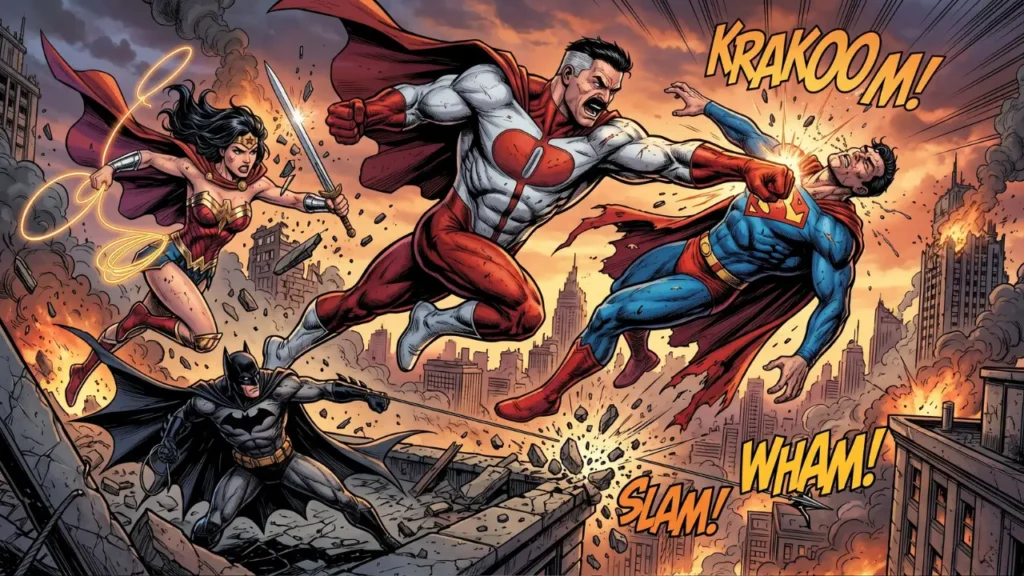
In short, the Justice League’s greatest asset against someone like Omni-Man is not raw power — it’s versatility and redundancy. They have members who can match him physically, members who can bypass his physical durability entirely, and one member whose entire value is finding the weakness nobody else thought to look for.
Core Roster for This Analysis
We’re working with the classic lineup: Superman, Wonder Woman, The Flash (Wally West), Batman, Green Lantern (Hal Jordan), Martian Manhunter, and Aquaman. This is the team that has, collectively, defeated cosmic-level threats across dozens of story arcs.
The Superman Factor: The Fight That Defines Everything
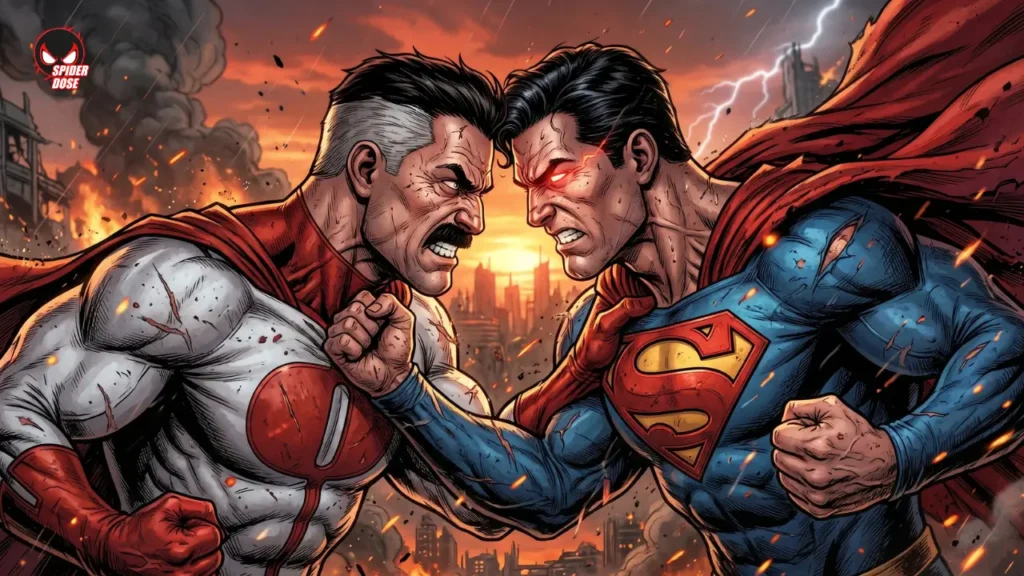
The question of whether Omni-Man could defeat the Justice League essentially hinges on one matchup first: Nolan vs. Clark Kent.
Physically, the comparison is close but not equal. If you want to understand how strong Superman really is in the comics, the answer is staggering — he has moved planets, survived supernovae, and operated at full capacity even after sustained damage. Post-Crisis Superman’s strength ceiling, powered by a yellow sun, exceeds Nolan’s fixed biological ceiling.
| Attribute | Omni-Man | Superman (Post-Crisis) | Wonder Woman (New 52) |
|---|---|---|---|
| Raw Strength | Planet-moving tier | Star-system tier | Island-busting tier |
| Speed | FTL in space | FTL (solar-powered) | Supersonic+ |
| Durability | Extreme (physical) | Near-absolute (solar) | Extreme (divine) |
| Regeneration | Moderate | Moderate–High | Moderate |
| Versatility | Low (physical only) | Very High | High |
| Kill Willingness | Absolute | Rare | Situational |
Therefore, in a direct, sustained fight, Superman wins — but it would not be quick or clean. Nolan fights dirty, and Clark often doesn’t. That psychological gap matters.



The Flash Problem: Speed Force vs. Viltrumite Reflexes
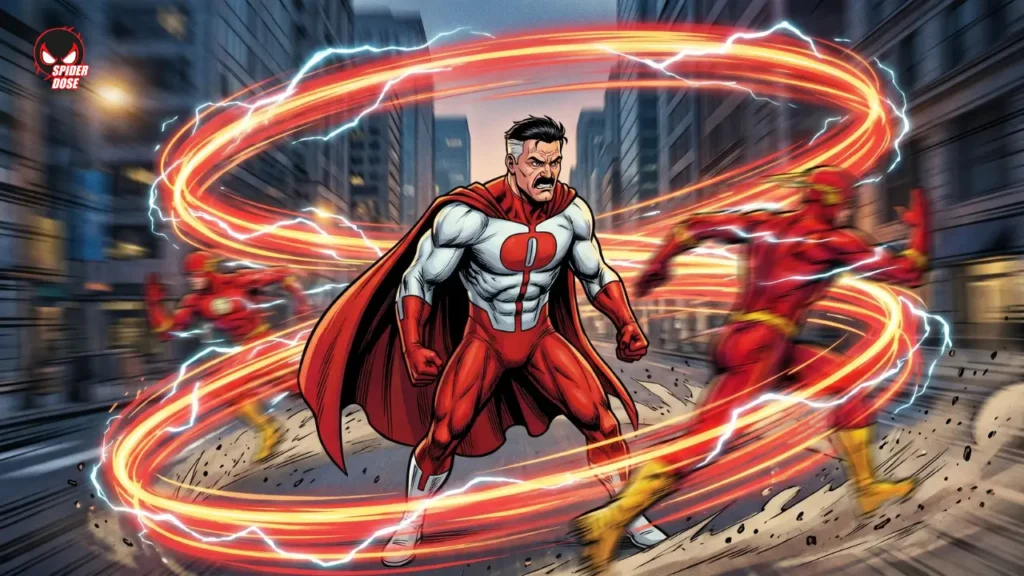
Omni-Man travels at faster-than-light speeds in open space. That sounds decisive until you understand what how fast The Flash actually means in combat.
Wally West, as the Flash, has moved at massively faster-than-light speeds in combat situations and has phased through solid matter at the subatomic level. More importantly, his Speed Force connection means his reaction speed in a ground fight operates on a fundamentally different scale than Nolan’s interstellar cruising speed.
In practice, Nolan has never faced someone who could vibrate through his body, deliver hundreds of punches before he blinks, or evacuate civilians faster than he can create hostage situations. The Flash doesn’t just outrun Omni-Man — he removes entire tactical options from Nolan’s playbook.
The Magic and Mental Threats: Where Nolan Gets Exposed
This section is where things get truly interesting. Omni-Man is a pure physical combatant. He has no mental defenses, no magical resistance, and no counter to energy-based or psionic attacks.
Martian Manhunter: The Quiet Threat
J’onn J’onzz presents a problem Nolan has no answer for in the comics. Viltrumite biology, while extraordinary, does not include psionic shielding. Furthermore, a direct telepathic assault from the Martian Manhunter — who has overwhelmed Brainiac-level intellects — could incapacitate Nolan before a single punch lands.
This is not speculation. In Invincible canon, Viltrumites are noted to have no established mental defenses against deep psychic intrusion. Their physiology is a fortress on the outside and comparatively vulnerable on the inside.
Wonder Woman: The Blade That Cuts
Diana’s magical weapons, including her sword and her enchanted armor, bypass conventional durability. This matters enormously because Viltrumite skin, while nearly impenetrable against physical impact, has shown vulnerability to weapons with sufficient magical or energy-based properties. Additionally, she brings 3,000+ years of combat experience — something even Nolan’s millennia-spanning military career cannot simply match, because Diana’s training is optimized specifically for defeating super-powered opponents.
Green Lantern: Constructs and Creativity
Hal Jordan’s power is only as limited as his willpower and imagination. Green Lantern’s constructs have restrained beings far stronger than Omni-Man in DC continuity. Moreover, Jordan could create a construct to exploit Nolan’s specific biological weaknesses — which brings us to the most underrated section of this entire analysis.
Omni-Man’s Critical Weaknesses: What High-Level Fans Know
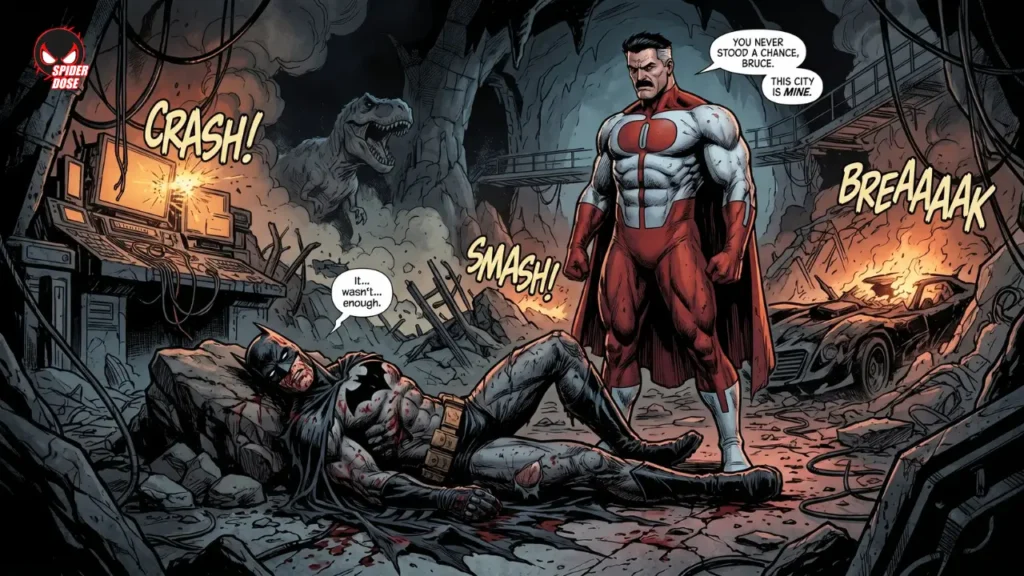
Most casual readers know Nolan is strong. Readers who know the Invincible comics deeply know how to beat him.
The Inner Ear Frequency Vulnerability
This is the Viltrumite Achilles’ heel. A specific sonic frequency disrupts the Viltrumite inner ear, causing extreme disorientation, loss of flight capability, and nausea. This weakness was weaponized in the comics to devastating effect during the Viltrumite War arc. Batman would identify this within hours. Cyborg could broadcast it continuously. The result? Nolan becomes a grounded, disoriented fighter — still powerful, but suddenly manageable.
Internal Organ Vulnerability
Viltrumite exterior durability is extraordinary. However, as shown in Nolan’s fight against Thragg and later in Invincible #110–130, internal trauma from sustained, focused attacks can be catastrophically effective. Superman’s heat vision, targeted internally, or the Flash vibrating matter through Nolan’s body, exploits this gap directly.
| Weakness | Who Exploits It | Effectiveness |
|---|---|---|
| Sonic frequency disruption | Batman, Cyborg | Disabling (grounds and disorients) |
| Telepathic vulnerability | Martian Manhunter | Potentially fight-ending |
| Internal organ damage | Superman (heat vision), Flash (vibration) | Severe injury risk |
| Magical weapons | Wonder Woman | Bypasses physical durability |
| No energy projection | Green Lantern, any energy user | Tactical gap |
Scenario Analysis: How the Fight Actually Goes
Scenario A — Surprise Attack (Nolan Has the Initiative)
This is where Omni-Man is most dangerous. His assault on the Guardians of the Globe in Invincible #7–8 succeeded precisely because they trusted him. If Nolan attacks the Justice League with zero warning and full lethal intent, the human-tier members — Batman, Green Arrow if present — are eliminated immediately. However, this scenario still ends badly for Nolan. Superman, Wonder Woman, and the Flash react at superhuman speed even when surprised. Martian Manhunter’s telepathic awareness makes a true ambush nearly impossible. Nolan might get thirty seconds of dominance. After that, the full League engages.
Scenario B — Direct Confrontation (League at Full Readiness)
With Batman’s tactical preparation and the full roster coordinated, this scenario is not competitive. Batman deploys the sonic frequency countermeasure. Martian Manhunter initiates a psychic assault. Flash removes any civilian leverage. Superman and Wonder Woman engage physically while Green Lantern maintains containment. Nolan is an extraordinary fighter, but he is one fighter — and the Justice League was specifically designed as a team to defeat threats no single hero could handle. Therefore, in a prepared confrontation, Omni-Man loses.
Our Verdict: The Logical Conclusion
So, could Omni-Man defeat the Justice League? Here is our clear answer: No — not the full, prepared Justice League from DC’s main continuity. He would destroy the human-tier members in seconds and make the early phase of any fight terrifying. However, Superman’s solar-powered strength ceiling exceeds Nolan’s fixed biological limit, the Flash neutralizes his speed advantage in combat, Martian Manhunter bypasses his physical defenses entirely, and his inner ear vulnerability gives Batman and the support members a fight-ending tool.
Nolan wins against a distracted, unprepared League for approximately the first sixty seconds. After that, the numbers, the versatility, and the specific countermeasures overwhelm him. The same qualities that make him dangerous — his single-minded physicality, his biological fixed limits, his lack of energy projection — become liabilities against a team built around redundancy and adaptive tactics.
He’s not outmatched. He’s just not designed to win this particular war.
Frequently Asked Questions | Omni-Man defeat the Justice League
Can Omni-Man survive a hit from Superman?
Yes. Omni-Man’s Viltrumite durability is extreme, and he can survive blows from characters at Superman’s power level — as demonstrated in his fights against comparable Viltrumites. However, sustained combat would accumulate damage he cannot quickly regenerate.
What is Omni-Man’s main weakness against the Justice League?
His primary vulnerabilities are the Viltrumite sonic frequency disruption (targeting the inner ear), telepathic attacks from Martian Manhunter, and his lack of any energy projection or magical defense — all of which the Justice League can exploit simultaneously.
Would Omni-Man beat Superman one-on-one?
In a prolonged fight, Post-Crisis Superman likely wins due to his solar-powered strength ceiling exceeding Nolan’s fixed biological limits. In a short, brutal ambush, Nolan’s willingness to kill immediately gives him a meaningful advantage.
Could Batman stop Omni-Man?
Not alone. However, Batman’s critical contribution is identifying and deploying the Viltrumite sonic frequency weakness, which would disable Nolan’s flight and equilibrium — making him manageable for the rest of the team.